

Your skin is constantly renewing itself. Every day, new cells form in the deeper layers of the epidermis and begin their journey toward the surface, where they replace cells that have completed their life cycle.
Although we can’t see it happening, this process is continuous and requires something essential: nutrients, energy, and a metabolism capable of putting them to work.
Skin Cell Renewal: A Process That Never Stops
The key players in this process are keratinocytes, the cells that make up most of the epidermis.
As they multiply and differentiate, they produce essential components that help form and maintain the skin’s protective barrier. This work involves synthesizing proteins, organizing lipids, and using energy to support cellular functions.
But where do the resources needed for all this activity come from?
To a large extent, from the nutrients our bodies obtain through food.
Which Foods Support Skin Health?
A varied diet provides the nutrients involved in tissue maintenance. Among them, lipids and proteins play particularly important roles.
Lipids: Protection and Hydration
Lipids are part of cell membranes and the skin barrier, helping limit water loss and protect the skin from environmental stressors.
Ceramides, cholesterol, and fatty acids are essential components of this barrier.
Where can we find healthy fats?
- Avocados and olive oil.
- Walnuts and almonds.
- Chia seeds and flaxseeds.
These foods provide different types of fats, including essential fatty acids that our bodies must obtain through our diet.
Proteins: Structure and Maintenance
Proteins provide amino acids that our bodies use to build and maintain tissues.
In the skin, proteins such as collagen contribute to the structural strength of the dermis, while keratins are essential for the organization and protection of the epidermis.
Which foods provide protein?
- Lentils, chickpeas, and beans.
- Tofu, soybeans, and soy-based products.
- Eggs and dairy products.
Getting enough protein helps ensure the availability of amino acids needed to synthesize many cellular components.
What Does Metabolism Have to Do With Skin Renewal?
Quite a lot!
Nutrients provide essential resources, but our cells need to process and use them. That’s where metabolism comes in: the collection of chemical reactions that allow our bodies to produce energy, build molecules, and maintain essential functions.
In the epidermis, these processes support the proliferation and differentiation of keratinocytes, as well as the production of components needed to maintain the skin barrier.
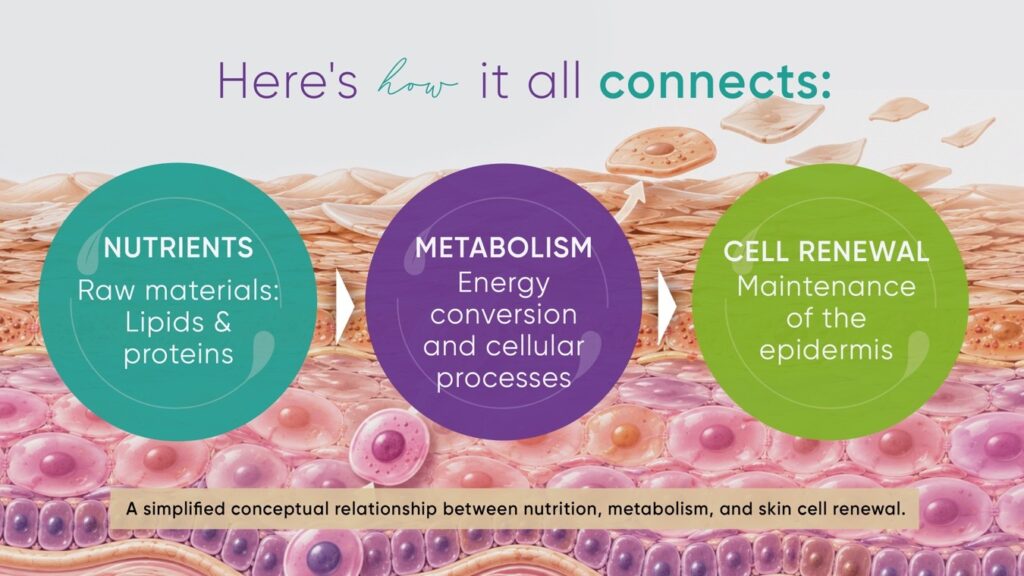
Food provides the resources. The metabolism allows our bodies to use them. Cells rely on those resources to maintain and renew the skin.
What Happens When Nutrients Are Lacking?
Nutritional deficiencies can affect various functions throughout the body, including those related to skin health.
For example, insufficient protein intake can compromise tissue maintenance and repair. Deficiencies in certain essential fatty acids can also affect the integrity of the skin barrier.
This doesn’t mean that every skin concern has a nutritional cause. It simply means that adequate nutrition is one of the conditions needed to support healthy skin function.
Does Eating More Protein or Fat Speed Up Skin Cell Renewal?
Not necessarily.
Our bodies continuously regulate cellular processes. Consuming more nutrients than we need doesn’t mean our skin will renew itself faster, produce more collagen, or automatically restore its balance.
What matters is maintaining a sufficient, varied, and balanced diet that provides the resources our bodies need.
Renewal Also Begins From Within
Skin renewal is much more than a surface-level process. It’s the result of continuous cellular activity involving nutrients, energy, and multiple biological mechanisms.
Understanding this connection reminds us that our skin’s health is closely linked to the health of our bodies as a whole.
At Green Wave, we believe that caring for your skin begins with understanding it. Because renewal isn’t just about changing what we see on the outside. It’s also about recognizing everything our bodies do to maintain balance.
Scientific Source: Jiang, N., et al. (2025). Role of Nutritional Elements in Skin Homeostasis: A Review. Biomolecules, 15(6), 808.