

Even when it looks the same in the mirror, your skin is changing all the time.
New cells are produced in the deeper layers of the epidermis. As they mature, they move toward the surface, transform, and become part of the barrier that protects us from the outside world and helps prevent excessive water loss. Eventually, cells at the surface are shed and others take their place.
Skin cell renewal is a continuous, natural process. But there’s something even more interesting: it doesn’t happen in exactly the same way at every hour of the day.
Your skin has its own clock.
What is your skin’s circadian rhythm?
The human body follows biological rhythms that operate on an approximately 24-hour cycle. Sleep and wakefulness may be the most obvious example, but they’re far from the only ones.
Your skin has its own circadian clocks, too.
Skin cells express genes associated with these internal clocks, helping coordinate different functions depending on the time of day. Research has found circadian variations in processes such as keratinocyte proliferation, DNA repair, barrier function, skin temperature, and blood flow.
In other words, your skin isn’t a static organ functioning exactly the same way 24 hours a day.
It has a rhythm of its own.
What changes in your skin between day and night?
During the day, our skin is exposed to ultraviolet radiation, pollution, temperature changes, and other environmental factors.
Circadian biology helps coordinate mechanisms involved in protection against these exposures, oxidative stress, and cellular damage repair.
At night, the context changes. Several skin functions vary throughout the 24-hour cycle, including barrier permeability, transepidermal water loss, and certain processes related to cell proliferation and repair.
That doesn’t mean your skin “switches off” during the day and “repairs itself” exclusively at night.
Protection, renewal, and repair are continuous processes. What changes is their rhythm.
What do we really know about skin cell renewal at night?
In skincare, we often hear that “your skin regenerates at night.”
Science tells a more interesting story.
The skin contains molecular clocks that help coordinate cellular activity with cycles of light and darkness. Epidermal cell proliferation and DNA repair mechanisms show circadian patterns, although researchers are still studying how these rhythms translate into specific clinical recommendations for people.
That’s why assigning an exact hour when your skin suddenly begins to “renew itself” would be an oversimplification.
Your skin is continuously renewing itself. Its biological activity changes throughout the day.
And sleep appears to matter.
In a controlled study involving healthy adults, restricting sleep to two hours per night for several days delayed the recovery of an experimentally disrupted skin barrier. Average recovery time increased from approximately 4.2 days with adequate sleep to 5 days under sleep restriction.
Sleep, then, isn’t simply a time when we stop doing things. It is also part of the conditions in which our bodies carry out their normal maintenance and recovery processes.
What can disrupt your skin’s circadian rhythm?
Our biological clock responds primarily to cycles of light and darkness, but our habits can also affect circadian synchronization.
Sleep loss or restriction is one factor that has been studied in relation to skin barrier recovery.
Environmental exposure matters, too. UV radiation can damage DNA in skin cells, while pollution has been associated with changes in barrier function and increased transepidermal water loss.
Age also brings changes to many skin processes, including hydration, barrier composition, and recovery capacity.
So when we talk about skin cell renewal, we’re not talking only about what we apply to our skin.
Skin is part of an entire organism, responding to what happens both outside and within it.
How can you support natural skin renewal without trying to force it?
For years, much of the language surrounding skincare has been built around one idea: making skin change faster.
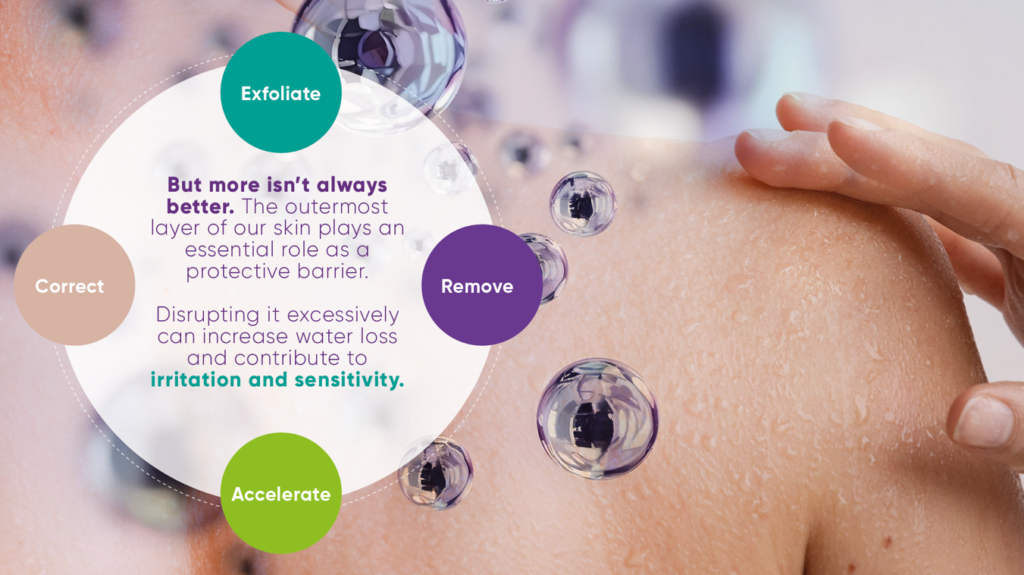
Exfoliate. Remove. Accelerate. Correct.
But more isn’t always better. The outermost layer of our skin plays an essential role as a protective barrier. Disrupting it excessively can increase water loss and contribute to irritation and sensitivity.
Conscious skincare begins somewhere else: protecting your skin during the day and supporting its natural maintenance and recovery processes.
That includes simple but meaningful habits: protecting your skin from UV radiation, maintaining adequate hydration, avoiding unnecessarily aggressive interventions, and recognizing that rest is part of our biology, too.
It’s not about trying to control every cell. It’s about creating supportive conditions for a process your body already knows how to carry out.
RENEWAL: Being aware that your skin is changing even while you sleep
Renewal doesn’t mean starting over. And it doesn’t mean forcing your skin to constantly become a “new” version of itself.
RENEWAL means being aware that change is already happening.
While you work, go about your day, rest, or sleep, millions of microscopic processes continue without you ever having to think about them.
Your skin protects. Responds. Repairs. Replaces cells. It maintains a barrier between your body and the world, and tomorrow, when you look in the mirror again, it will probably look the same. But it won’t be exactly the same.
While you were reading this article, your skin kept renewing itself. Give it the care it needs to keep going.💚