

Gratitude goes beyond words.
Some words become such a natural part of our daily lives that we barely stop to think about them. “Thank you” is one of them. We say it when someone helps us, when we receive a gift, or when we appreciate a kind gesture. But what happens when gratitude becomes more than an occasional response and turns into a way of looking at life?
Being grateful doesn’t mean everything has to go perfectly. It means learning to recognize what matters, even during difficult times. It is a conscious choice we can cultivate, and research suggests that practicing gratitude may support our emotional well-being, relationships, and even the quality of our sleep.
Gratitude Is an Attitude Toward Life
At Green Wave, we believe well-being goes beyond the skin. It is also reflected in how we connect with ourselves, the people around us, and the experiences that shape our lives.
From this perspective, gratitude isn’t about collecting reasons to feel fortunate or finding something positive in every situation. It is about noticing what we often take for granted: a meaningful conversation, someone who was there when we needed them, an unexpected opportunity, or simply a peaceful moment in an ordinary day.
Being grateful doesn’t mean ignoring life’s challenges. We can experience sadness, uncertainty, or exhaustion while still recognizing something valuable in our lives. Both experiences can exist at the same time.
That is why gratitude is more than a passing emotion. It is a practice that encourages us to live with greater awareness and discover that meaningful moments don’t always require extraordinary circumstances.
What Does Science Say About the Benefits of Gratitude?
Gratitude has attracted growing interest in psychology because of its potential connection to emotional health, well-being, and human relationships. Although its effects vary among individuals and circumstances, several studies have revealed interesting findings.
Gratitude and Emotional Well-Being
In 2003, psychologists Robert A. Emmons of the University of California, Davis, and Michael E. McCullough of the University of Miami published a study examining the effects of consciously focusing on experiences for which we feel grateful.
Participants completed reflection exercises and kept records of everyday experiences. Compared with other groups, those who practiced gratitude showed improvements in several measures of well-being, particularly positive emotions.
Some findings also suggested benefits for interpersonal relationships, including a greater willingness to offer emotional support to others.
These results suggest that taking time to recognize the value of our experiences may positively influence how we feel and how we connect with the people around us.
Gratitude and Sleep Quality
Could the thoughts we have before bedtime be connected to how well we sleep?
A 2009 study published in the Journal of Psychosomatic Research, led by Alex M. Wood and colleagues, explored the relationship between gratitude and sleep in 401 adults.
Researchers found that people with higher levels of gratitude tended to report better sleep quality, longer sleep duration, and fewer difficulties falling asleep. This association was partly related to having more positive and fewer negative thoughts before bedtime.
It is important to note that this was an observational study, meaning it does not establish that practicing gratitude can treat sleep problems. However, its findings invite us to reflect on the importance of the thoughts we carry with us at the end of the day.
Perhaps taking a few moments to acknowledge something good we experienced can be a gentle way to close our day.
How to Practice Gratitude Every Day
Gratitude doesn’t require elaborate rituals or special circumstances. Like any habit, it can be cultivated through small, consistent actions.
Appreciate everyday moments. Start your day by identifying something you value in your life. It might be a person, an experience, an opportunity, or something as simple as enjoying your favorite breakfast.
Express how you feel. Sometimes we assume people already know how much we appreciate them. Telling someone why you’re grateful for their presence can turn a personal feeling into a meaningful moment of connection.
Take a moment to pause. Between responsibilities, commitments, and daily tasks, give yourself a few moments to notice what’s happening around you. Gratitude often begins with paying attention.
Write before bedtime. Think of one or two moments from your day that held special meaning. They don’t need to be extraordinary. What matters is recognizing why they were valuable to you.
Practice gratitude without pressuring yourself to feel happy. Some days, finding reasons to be thankful may feel difficult. You don’t need to force an emotion or deny what you’re going through. Gratitude is an invitation, not an obligation.
A Five-Minute Gratitude Meditation: A Moment to Reconnect With Yourself
We invite you to take a moment just for yourself.
Find a quiet place, settle into a comfortable position, and close your eyes if you wish. Breathe slowly, without trying to change anything. Allow your attention to settle into the present moment.
Think of someone who has brought something meaningful into your life. Remember a gesture, a conversation, or an experience you shared. Acknowledge what that moment meant to you.
Now bring your attention to something ordinary that you enjoy but may sometimes overlook. It could be the morning light, a space that brings you peace, or an activity that makes you feel good.
Finally, think of something you appreciate about yourself: a decision you made, an effort you put in, something you learned, or the way you supported someone else.
Take one more gentle breath and stay with that feeling for a few moments.
You don’t need to experience any particular emotion. Simply taking time to recognize what matters to you is enough.
A Gift to Help You Practice Gratitude
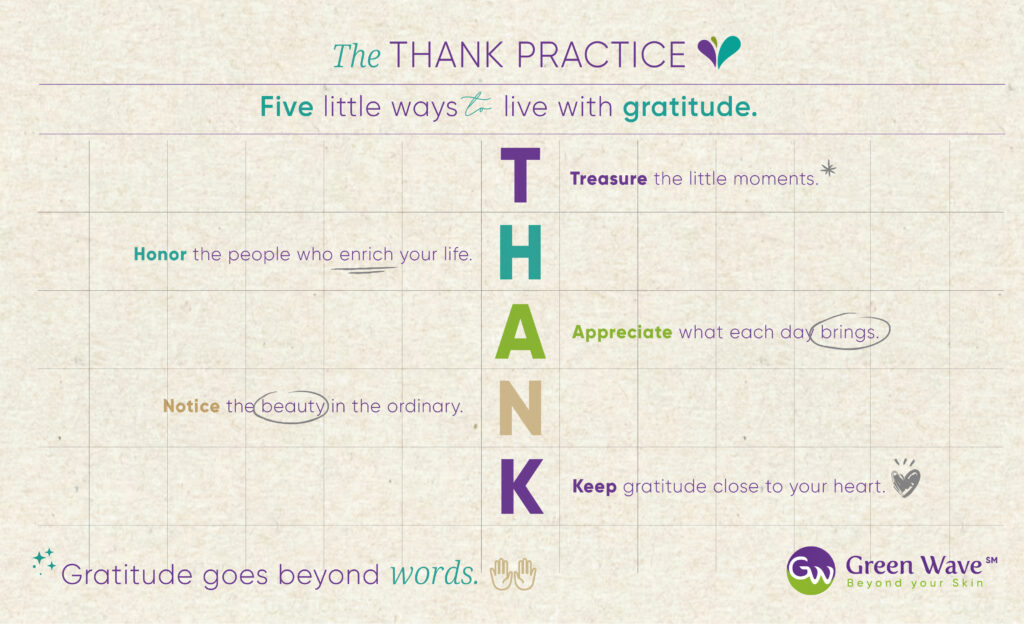
At Green Wave, we want this reflection to go beyond words. That’s why we’ve created THE THANK PRACTICE: Five Little Ways to Live with Gratitude, a simple downloadable guide inspired by five meaningful actions: treasure, honor, appreciate, notice, and keep.
Each one is an invitation to recognize what matters, appreciate the people around you, and discover the beauty in everyday moments. A gentle reminder that gratitude is something we can practice, one small gesture at a time.
Because gratitude isn’t only about appreciating what we receive. It’s also about learning to value what we experience, what we share, and who we are, and that is something we can practice every day.
Gratitude goes beyond words. Gratitude is something we feel, practice, and live.
Verified Scientific Sources
- Emmons, R. A., & McCullough, M. E. (2003). Counting Blessings Versus Burdens: An Experimental Investigation of Gratitude and Subjective Well-Being in Daily Life. Journal of Personality and Social Psychology. Greater Good
- Wood, A. M., et al. (2009). Gratitude Influences Sleep Through the Mechanism of Pre-Sleep Cognitions. Journal of Psychosomatic Research. PubMed